| HOME<Product<Semiconductors/Electricity/Electronics-related fields |
|
|
| |
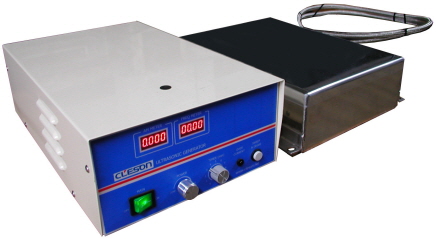
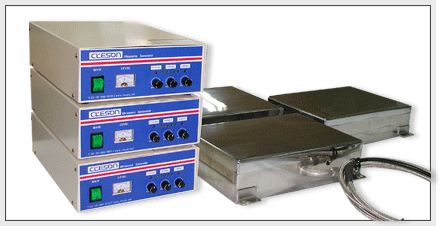
 Basic Specifications of Ultrasonic Generator Basic Specifications of Ultrasonic Generator
|
 |
MODEL |
CLGT 600 |
CLGT 1200
|
ULTRASONIC POWER
(W)
|
600
|
1200 |
FREQUENCY (kHz)
|
28 / 40
|
28 / 40
|
GENERATOR
|
INPUT POWER |
AC220 /
50Hz or 60Hz |
AC220 /
50Hz or
60Hz |
SIZE (mm) (WxLxH)
|
270X400X120
|
270X400X120
|
WEIGHT (kg)
|
15
|
15
|
TRANSDUCER
|
TEMP. (℃)
|
Normal 60 (Max. 90) |
Normal 60 (Max. 90) |
BODY MATERIAL
|
SUS304 or SUS316 |
SUS304 or SUS316 |
| SIZE (mm) (WxLxH) |
300X230X110
|
300X280X110
|
| WEIGHT (kg) |
12~15
|
17~20 |
|
 Relationship between Ultrasonic Output and Parts Relationship between Ultrasonic Output and Parts |
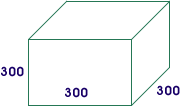
If 250W ultrasonic waves are emitted to the tank as shown in the figure below, it is possible to clean parts amounting to 10% of a total amount of a detergent with which can clean within the same time. If 500W is emitted, it is possible to clean parts amounting to 25% within the same time. This means that a larger ultrasonic output is required to clean a greater amount of parts, even though the tank is the same size.
The level of ultrasonic output used in most ultrasonic cleaners is 1W/Cm² (area of ultrasonic generation in a cleaning tank)
 |
|
| 250W -- 10% of the total |
500W -- 25% of the total |
1000W --50% of the total |
|
|
|
|
 |
| |
| Application principles of ultrasonic waves |
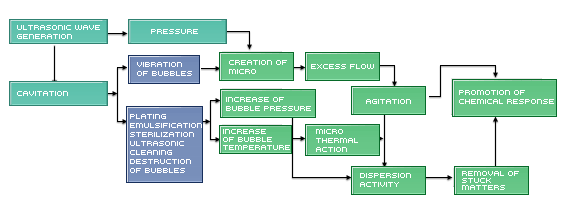
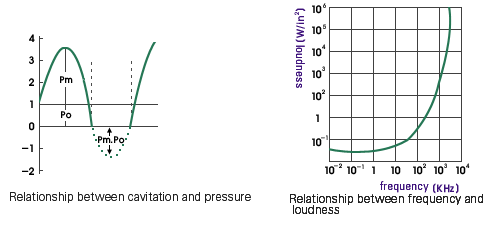
Ultrasonic waves are sound waves, with a rate of vibration too high to be heard with human ears. If ultrasonic waves are emitted in a liquid, contraction and expansion occurs in the liquid in turn, as the waves are spread into the liquid. If ultrasonic energy increases, cohesion is destroyed among the liquid molecules, and over tens of millions of minute cavities are formed. This phenomenon is called “cavitation”. When these cavities are exploded, they emit a powerful energy. By virtue of this shocking wave, thorough cleaning is performed within a short time, without damaging the surface or the interior of parts in the liquid. This is the safest, fastest, and most thorough cleaning method for metals and nonferrous metals.
|
|
| |
| Diagram of application principles |
|
 |
|
| |